
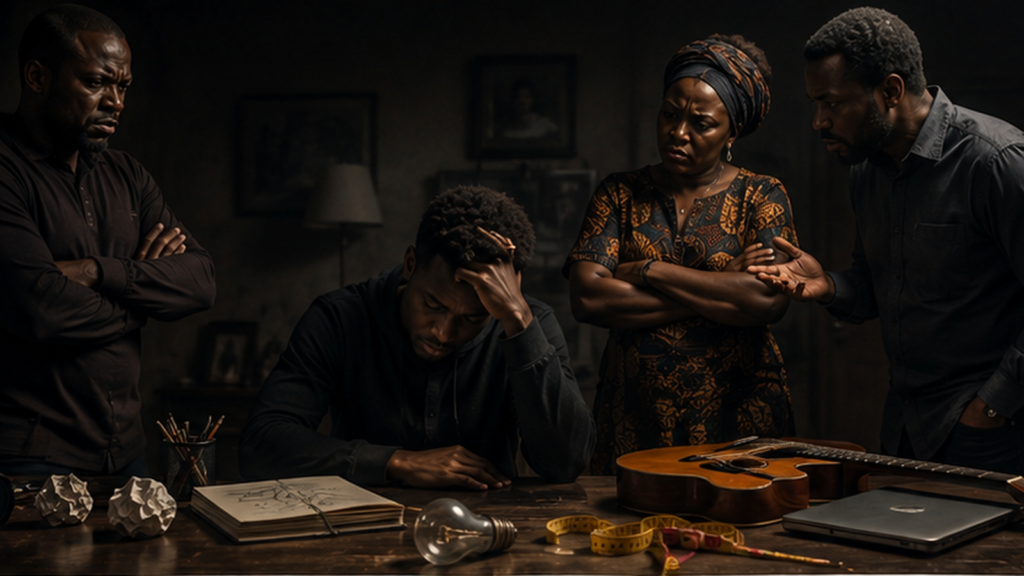
If you see a spark in your child, niece, nephew, or cousin and you blow it out or dismiss it because it’s not a “lawyer, doctor, engineer” kind of path, don’t act surprised years later when the house feels cold and that same child grows up with frustration, anger, and a quiet resentment that follows them into every job, relationship, and room they enter.
I am not a parent yet, but from psychology classes, therapy stories, and just watching people around me, the pattern is too clear to ignore. So many bitter adults trace their core wounds back to sentences such as: “That thing won’t put food on the table anyway.” “You’re wasting your time and youth on frivolous things.” “Those are just hobbies, not a real job.” “Can’t you see what your mates are doing?” “As my elder, I’m ashamed to tell my friends what you do.” “I pray God opens your eyes. You’re wasting your purpose.’’And I wonder: How did we forget that unique talents also come from God?
As Africans, we grow up hearing, “Be realistic.” But being realistic without being humane creates adults who are talented, angry, and lost. The goal of this piece isn’t to force every talent into money or downplay traditional, respectable career paths that take long academic years to achieve. The goal is simple: don’t kill the light that talents or vocational passions bring and then wonder why the house became dark.
Ten to 15 years ago, who would have thought Nigerian/African fashion would walk Paris, London, and New York runways? Who would have thought Afrobeats would fill arenas in London and New York and appear on global charts? Who would have thought that wig-making, makeup, cake design, event planning, farming, and even content creation would become billion-naira industries?
“Content creator” wasn’t even a job title in 2015. Today, a 19-year-old with a phone can build a career from a showcased talent parents once called a “distraction.” We keep calling kids “unrealistic” in a world that rewards the exact things we told them to kill. These talents can become legitimate career paths, create wealth, and bring global attention to our country in ways we could never have imagined.

So what actually happens when you dismiss a child’s talent? Here’s what it looks like. Firstly, resentment becomes their origin story. You’ll hear something like “My parents and family never believed in me.”
It doesn’t matter that you paid school fees, bought clothes, or attended PTA meetings. If you laughed at the drawing, if you yelled at the dancer or house gymnast to “face her books!” if you called the YouTuber “time-wasting,” or if you said, “I’ve washed my hands off you and this hobby,” that’s the memory that sticks.
For a perfect illustration, Temi is 28 now. A brilliant analyst in the United Kingdom, she earns what most consider a fantastic salary monthly. In SS2, she won a state art competition. Her dad said, “Art won’t feed you. Read your physics, learn your coding, and be more serious with school.” Never, “Congratulations, my child. More wins.”
Last month at dinner, she said, “Imagine if you’d just bought me that large drawing board to keep practicing after I won the art championship in school. I wouldn’t have spent five years hating myself and hating to see art shows and displays today.” The money came but the wound stayed.
Then there’s the frustration transfer which goes something like: “With small support, I’d have been there too or even better.” The truth is that kids are not blind. They see classmates with vocal coaches, enrolled to football academies, whose parents buy cameras, and allow them have studio time. They see parents who drive their kids to auditions and pay for skill acquisition during holidays. Then the child looks at you and thinks: “I could have done it with half of that.”
That pain doesn’t vanish. It transfers into anger, withdrawal, self-sabotage, quitting halfway, picking fights at every little provocation, and sometimes giving up altogether.
Here are further examples. A man I know works in Oil and Gas. He gets triggered whenever people watch talent shows around him. In therapy, he revealed that his father used to lock him in the basement after flogging him for sneaking out to “bass” concerts. “If you want to waste your life, stay with the rats. I am your father. What I want you to do is final,” he was told.
There’s a girl’s mum that would drag her out of tennis practice shouting, “You’re a girl! This will spoil your womb!” Now imagine her watching sports on TV and seeing female sports champions.
The trauma is real. Or what of on Nigerian Idol, a contestant cried and admitted she snuck out of her house for auditions because she was terrified of her dad’s reaction and the punishment he would mete out to her for taking those bold steps. That’s what suppression does. It doesn’t kill talent. It buries it alive.
Now, let’s look at late regret. By 25, 30, or 40, the “what ifs” start. The child will say “What if Mum let me do dance classes? What if Dad didn’t sell the camera I saved for? What if they just had a leap of faith in me?”
Some at that stage, take the bull by the horns and damn the consequences. The parent would say “I should have tried. I should have shown interest. She would have gone far in this.” “See what other children are creating see how other children are being celebrated.” But by then, confidence is gone. Windows have closed, and you both sit with regret at different tables.
An example, in 2020, teenagers were posting covers on TikTok. Parents who said, “post it,” now have kids with record deals, making six figures from live streams and starting trends by building online communities, have turned those talents to sellable niches and coach people both online and offline.
Parents who said, “Delete that nonsense and be more serious and focused like your school mates,” now have kids who deleted themselves instead. Talents that looked like hobbies and past times in 2010 are industries in 2026: content, gaming, fashion, blogging, vlogging, travel documentaries, animation, comedy, sports, catering, art collecting, and many more.
Nurturing is not “quit school and go pro”. It is three things:
1. Validation: “I see you. This matters. We can groom it during the holidays.
2. Micro-support: Four hours a weekend, a YouTube beginner’s tutorial with paid data after school assignments are completed. Transport to training school. Sign your kids up for networking with peers. Buy a cheap mic for home practice. Pay for and enroll your child in affordable skill-acquisition centers. Show interest in skill-acquisition programs at church they are usually subsidized for members. Because when jobs fail, skills keep you alive.
3. Protection: Don’t let teachers, relatives, or your own fear talk them out of it. Kids need to feel that what lights them up is valid. If not, they either kill the talent or kill parts of themselves to please you.
Fifteen years later, we wonder why they’re depressed. Why they resent us. Why they can’t commit. Some rebel hard. Some turn to drugs.
I know a lady whose mum said, “Over my dead body will you do this.” She waited for her mum to die before pursuing her gift. Hurts but it happened. And it hurts the most when parents gaslight, praising other children for doing exactly what their own child does better.You don’t have to bet the house on it. But you do have to water it.
Ask, “What do you need from me to get 10% better at this?” Show up to one recital. Share one post. Buy one book. Treat it like it’s real, because to them, it is.The world is no longer rewarding only “conservative” academic careers. The kids who were called “distractions” in 2010 are the ones setting trends in 2026. Why not groom the light in your own house?

Hilda Baci might not have broken a world record without her mum and brother’s support and backing. Veekee James once bought her brother a car and said, “This is small compared to how you carry my tailoring on your head’’. The way she went all out for his wedding spoke volumes than words. Imagine if her brother had dismissed her. Sibling rivalry would have replaced sibling pride.
I watch content from fantastic creatives I draw inspiration from across social media such as: Didi Lusso, Lala the bead maker, Merit beads, Dunsin recyclers and many more and instantly I know they have strong family backings or in some cases, their family members came around and it’s so good to see.
The truth is simple: If you dim what makes them come alive, don’t be surprised when they spend adulthood trying to get that light back sometimes in destructive ways.
A friend said it best: “Talents you suppress will find a way to come back. One generation at a time.” Don’t kill the light. Then wonder why the house is dark.
As for adults who were denied the opportunity to shine through their talents, may you heal so deeply that you remember what it feels like to be excited about your future, your creativity, and your life.
First published in Pioneer Progressive Herald, Vol. 1, No. 26, August 23, 2026.